
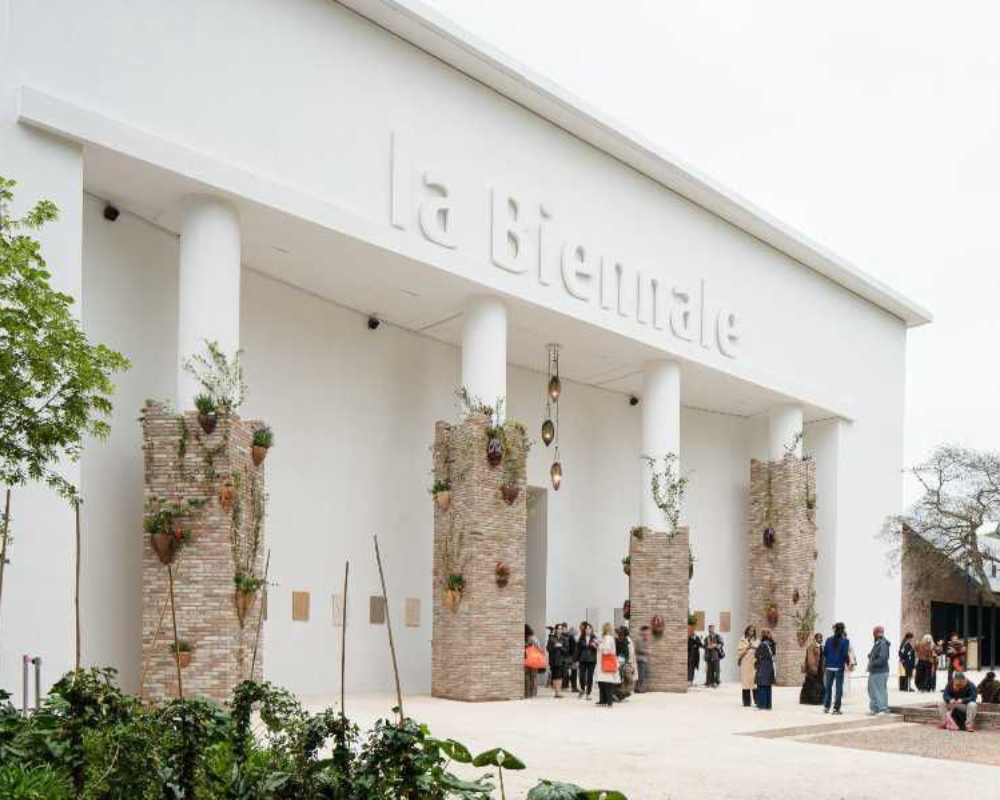
The 61st International Art Exhibition, titled In Minor Keys, unfolds under exceptional circumstances. Conceived by Koyo Kouoh before her sudden passing in 2025, the Biennale proposes a more intimate and sensitive reading of the world, one attentive to silence, fragility, ritual and non-hegemonic forms of knowledge. Yet the opening days were marked by intense geopolitical tensions that transformed Venice itself into a site of confrontation between art and contemporary global conflicts.
Activists, artists and curators called for the closure of the Israeli pavilion and questioned the participation of Russia and even the United States within the current geopolitical climate. During the preview days, protests organized by groups such as the Art Not Genocide Alliance led to demonstrations around the Israeli pavilion, while Pussy Riot organized actions against Russia’s return to the Biennale after years of absence following the invasion of Ukraine. At least 27 of the 100 national pavilions were reported as partially or completely closed during one morning of the preview days, while artists participating in the central exhibition covered or altered works in gestures of solidarity. Among the pavilions affected by symbolic strikes or temporary closures were Austria, Belgium, Finland, France, the Netherlands, Ireland, Japan, South Korea, Lebanon, Luxembourg, Malta, Poland, Portugal, Spain and Turkey, among others.
In this climate of uncertainty and political fracture, In Minor Keys becomes something paradoxical: a Biennale simultaneously marked by instability and profound artistic intensity. Within this charged atmosphere, the Brazilian artists presented across Venice do not avoid these tensions, they move through them, transforming memory, spirituality, ritual and historical violence into new forms of visual and poetic resistance.
National Pavilion: Comigo Ninguém Pode, the Botanical Archaeology of Brazil
The Brazil Pavilion, curator Diane Lima presents Comigo ninguém pode, bringing together Adriana Varejão and Rosana Paulino in a deep dialogue. The title derives from the Dieffenbachia plant, popularly known in Brazil as “comigo-ninguém-pode,” activating ambiguous meanings of protection, toxicity and resistance. The pairing of the two artists establishes a powerful dialogue between practices that are fundamental to understanding Brazil’s colonial formation, its violence and its enduring structures.
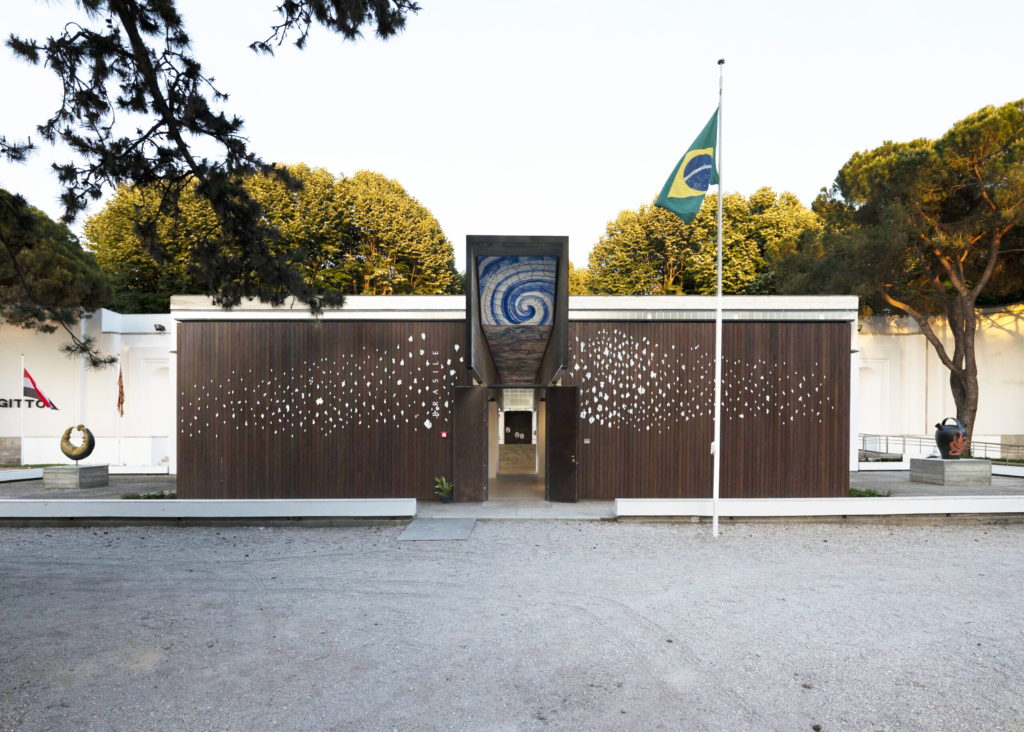
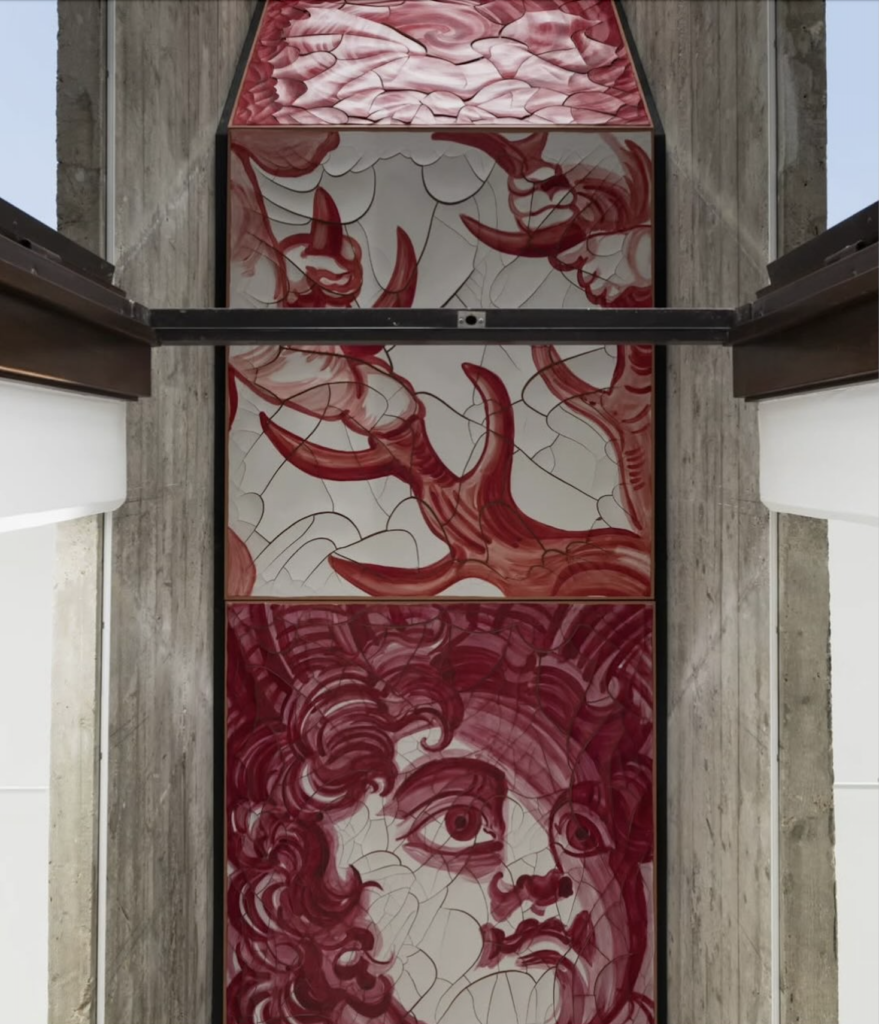
Rather than functioning as a neutral modernist structure, the pavilion is transformed into a fragmented spatial experience, where ruins, unfinished architectures, exposed beams and stair-like structures delineate a territory marked by the instability of Brazil’s historical foundations. Beginning with the cracked azulejo ceiling conceived by Adriana Varejão, the exhibition immediately questions the very structure of a country whose remains seem at risk of collapsing onto us. Some walls appear interrupted, structures partially collapsed, while suspended passages and forms suggest movement, transition and the possibility of rebuilding. This intervention creates the sensation of moving through a country under permanent reconstruction, a nation simultaneously haunted by colonial violence and driven by the ongoing desire to reinvent itself. In this sense, the pavilion ceases to operate as a stable representation of national identity and instead becomes a living territory of tension, memory and transformation.
For decades, Adriana Varejão’s practice has explored architecture as a wounded body. Her paintings, azulejos,Incisions a la Fontana and Ruinas Serie expose the violence concealed beneath a Brazil shaped by colonization, baroque aesthetics, miscegenation and violence inscribed upon bodies and spaces. Many of her works resemble ruins that still carry traces of life, trauma and memory. Her presence within the pavilion intensifies the sensation that Brazilian history remains physically embedded within its structures.
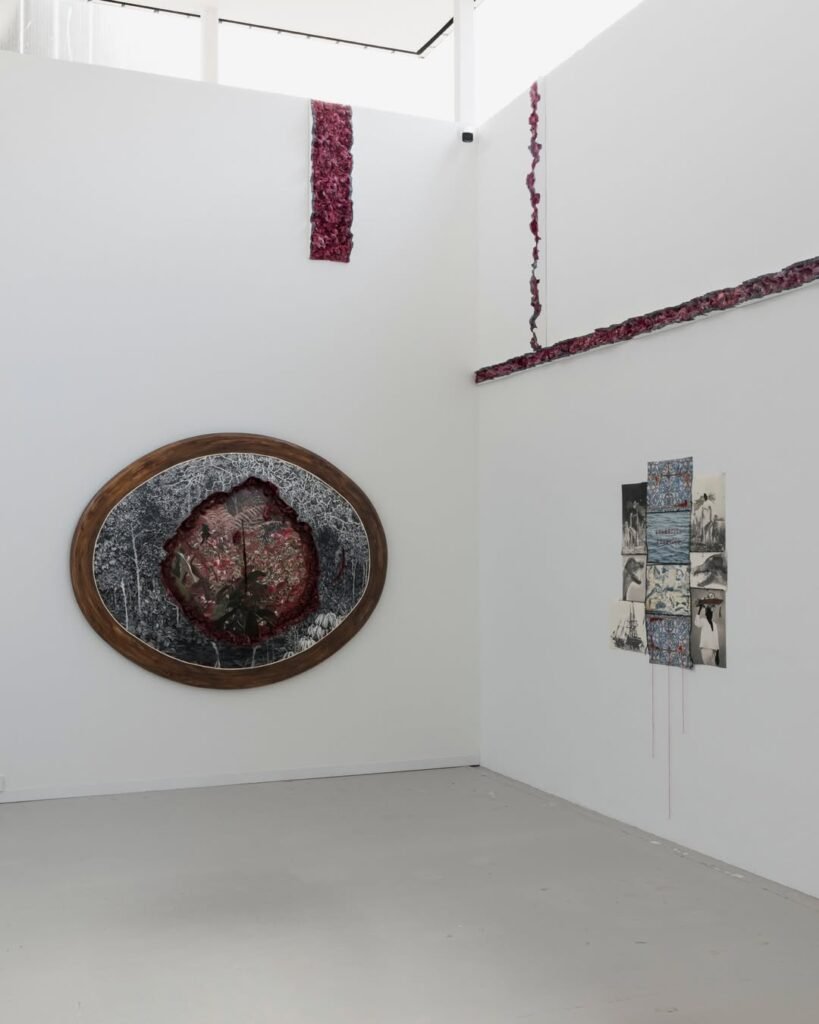
Among the works presented, Paisagem Canibal, 2003 stands out as a visceral landscape where tropical vegetation merges with wounded flesh, evoking a Brazil simultaneously fertile and violent, seductive and cannibalistic. The work, previously exhibited in earlier institutional contexts, belongs to an important Brazilian private collection.
Also presented is a ceramic vase developed during Varejão’s recent research period in Greece, in dialogue with the surreal and organic forms of Maria Martins. This body of ceramic works is represented by Gagosian, further reinforcing the artist’s growing international institutional and market presence.
Together, these works transform the Brazil Pavilion into a fractured architectural body where colonial memory, tropical imagination and historical violence coexist in permanent tension. Varejão’s work does not offer historical resolution; instead, it exposes the instability of the narratives upon which Brazil itself was constructed.
Represented by Gagosian, Victoria Miro and Flexa, her works belong to major collections including the Tate Modern, the Metropolitan Museum of Art, the Guggenheim Museum, the Dallas Museum of Art, the Stedelijk Museum, Serralves Foundation, Museo Reina Sofía and MASP; Inhotim also houses a permanent pavilion dedicated to the artist. Private works by Adriana Varejão are currently available for acquisition through Sophie Su Art Advisory. For further information, please contact us directly.
Rosana Paulino, meanwhile, operates through the critical reconstruction of memory, introducing another dimension: repair. Through sewing, embroidery, drawing, printmaking and the appropriation of archival imagery, her practice confronts the erasure of Black women from Brazilian history and reinscribes violated bodies into processes of healing, repair and affirmation, processes that do not deny violence, but transform it into collective memory. If Varejão exposes the wound, Paulino insists upon the possibility of suturing it.
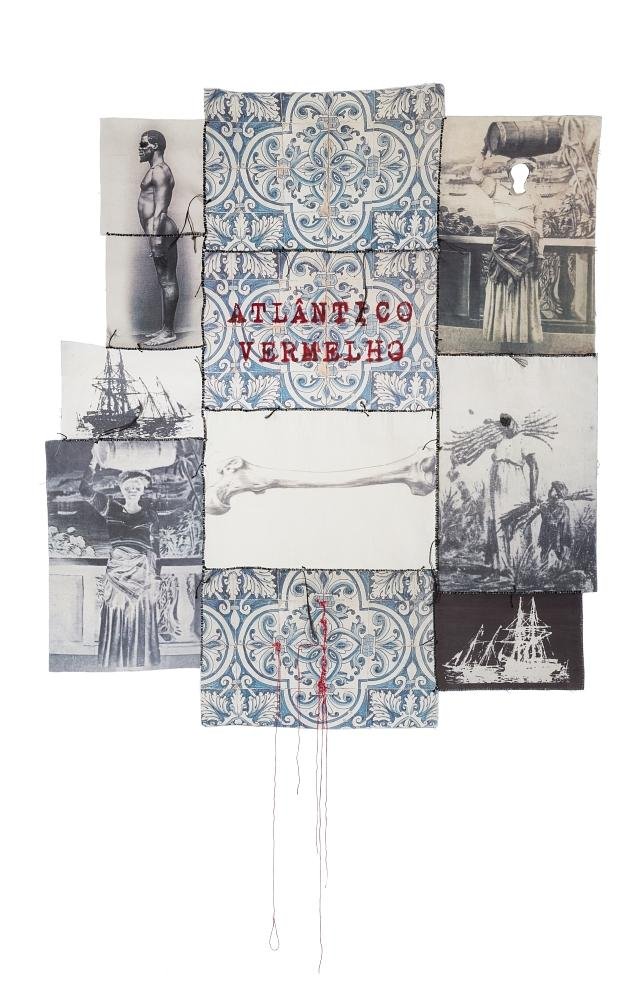
Several works presented at the Brazil Pavilion deepen this reflection on transformation, ancestry and resilience. In Atlântico Vermelho, 2027, Rosana Paulino deepens her investigation into the unresolved scars linking colonial history, race and gender in Brazil. Part of a broader series reflecting on the transatlantic crossing, the work evokes what the artist describes as “those who did not manage to arrive alive.” Through drawings and textile-based works, Paulino subverts materials historically associated with the feminine sphere, such as embroidery and fabric, transforming them into surfaces marked by rupture, violence and memory. Fragmented bodies, stitched wounds and layered textures reveal the persistence of historical trauma within contemporary Brazilian society, while the Atlântico Vermelho emerges as both sea and scar: a symbolic territory shaped by slavery, forced displacement and erased identities. Within the Brazil Pavilion, the work resonates directly with the exhibition’s fractured architectures and wounded landscapes, reinforcing the idea of Brazil as a nation still negotiating the ghosts of its colonial past through processes of repair, survival and transformation.
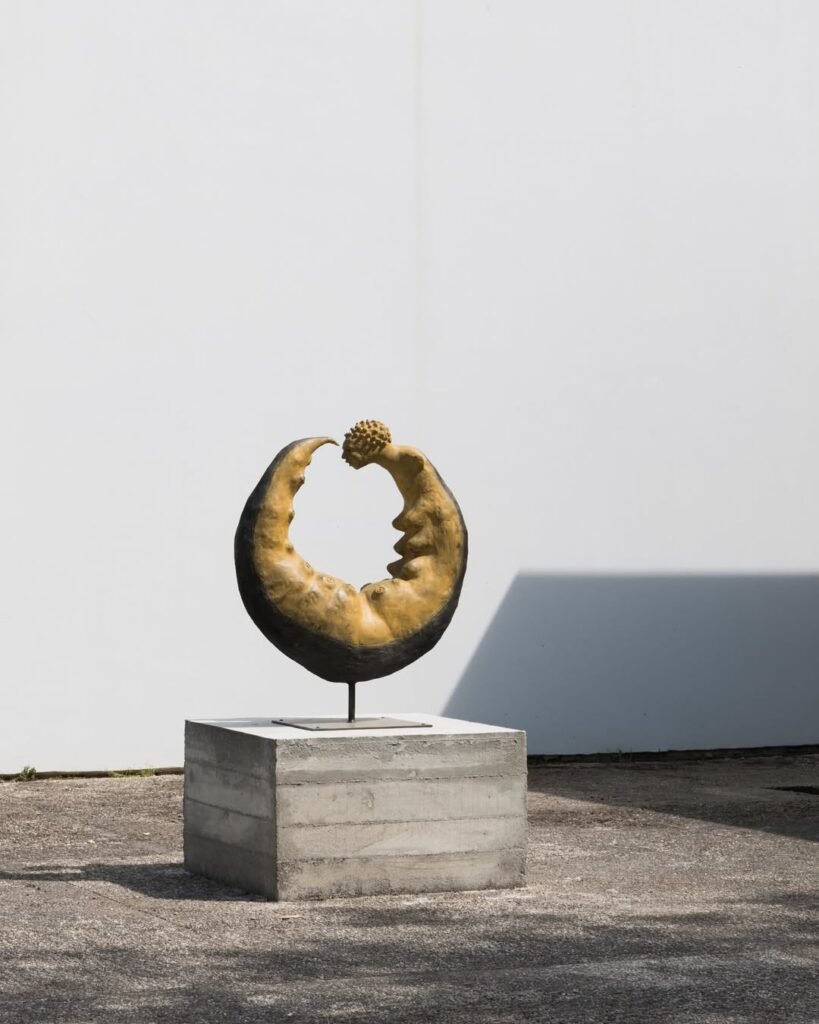
In Crisálida, 2026, Paulino expands the metaphor of metamorphosis through her first bronze sculpture. The work ultimately emerged from Ninfa Tecendo o Casulo, 2005, a drawing from Paulino’s Tecelãs series in which a female figure produces, from her own body, the threads forming a cocoon around herself. Transformed two decades later into bronze, Crisálida evokes a suspended state between trauma and transformation, where fragility itself contains the possibility of rebirth and continuity. Bodies appear caught in processes of mutation and emergence, reinforcing one of the pavilion’s central ideas: Brazil as a nation permanently oscillating between collapse and reinvention.
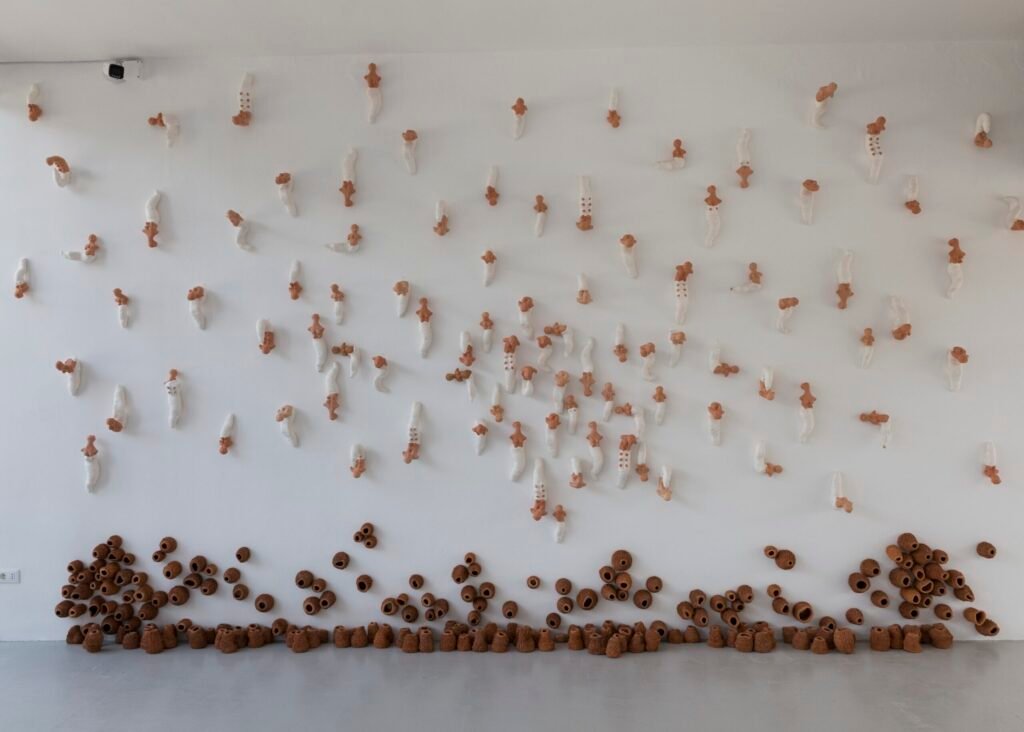
In Tecelãs, 2003, the artist continues her long-standing investigation into memory, ancestry and the historical condition of Black women in Brazil through organic and symbolic forms. The suspended ceramic elements evoke bodies, seeds, cocoons or spiritual presences in transformation, oscillating between fragility and resistance. Arranged across the wall like a constellation or a living archive, the forms seem to emerge collectively from the ground, creating a tension between ascension and rootedness. The terracotta vessels accumulated at the base reinforce associations with earth, fertility, ritual and containment, while also recalling archaeological remnants or sacred objects unearthed from forgotten histories. Within the context of the Brazil Pavilion, the installation resonates directly with the exhibition’s broader reflection on reconstruction and survival, proposing memory not as something fixed, but as a living material continuously capable of mutation, transmission and rebirth.
Represented by Mendes Wood, while also maintaining her independent platform through Rosana Paulino Studio, her works belong to institutions such as Museu de Arte Moderna de São Paulo, Pinacoteca de São Paulo, Museu de Arte de São Paulo, Museu Afro Brasil, Museo de Arte Latinoamericano de Buenos Aires and the University of New Mexico Art Museum.
There is a subtly surrealist atmosphere permeating the pavilion. Bodies seem to dissolve into landscapes, architectures become unstable, while memory assumes an almost dreamlike dimension. Yet this surreal aspect does not function as an escape from reality. On the contrary, it reveals the impossibility of narrating Brazilian history through purely rational or linear structures. Together, Varejão and Paulino do not illustrate an idea of Brazil; they place its foundations under tension while constructing a space oscillating between ruin and dream. One opens the skin of history; the other stitches together its fragments. One exposes colonial wounds through painterly and architectural matter; the other reconstructs genealogies ruptured by racial and patriarchal violence.
The Arsenale: Koyo Kouoh’s Spiritual Cartography
The Arsenale, the curatorial vision of Koyo Kouoh unfolds as one of the most spiritually and conceptually charged dimensions of the 61st Venice Biennale. Appointed as the first African woman to curate the Biennale’s central exhibition, Kouoh conceived In Minor Keys as a response to the violence, acceleration and fragmentation of the contemporary world, proposing instead a more intimate and sensitive listening to history, attentive to silence, memory, spirituality and marginalized forms of knowledge. Following her sudden passing in 2025, the exhibition was carried forward by her curatorial team with remarkable fidelity, resulting in an atmosphere that feels fragmented, ritualistic and deeply embodied, where visitors move not simply through artworks, but through states of perception shaped by decay, transformation and ancestral memory.
One of Kouoh’s central curatorial axes emerges through practices connected to the African diaspora, ancestry, the body, time, decomposition, memory and non-hegemonic forms of knowledge. Within this framework, the three Brazilian artists invited to the central exhibition, Ayrson Heráclito, Eustáquio Neves and Dan Lie, deepen the Biennale’s reflection on histories that persist through fragments, rituals, spiritualities and invisible processes of transformation.
Ayrson Heráclito: The Alphabet of the Orixás
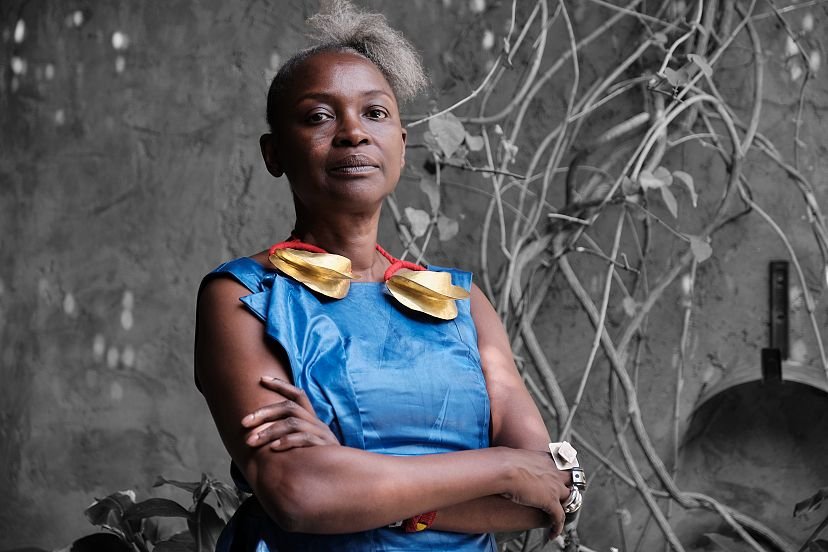
Ayrson Heráclito, artist, professor, curator and ogã within the Jeje Mahi Candomblé tradition, presents a practice deeply rooted in Afro-Brazilian cosmologies. The Biennale installation, composed of monumental stainless steel sculptures, spectacularly evokes the presence of spiritual entities, creating an immersive environment that resembles a sacred temple through which visitors can wander. Rising like columns supporting an ancient sanctuary, the works transform the space into a place of ritual, contemplation and mystery. Mysticism permeates the entire experience, alongside the desire to decipher the deeper meanings embedded within the installation. Conceived as part of the Juntó series, the project is based on the symbolic combinations between 16 orixás, generating 222 possible sculptural forms. For Ayrson Heráclito, these combinations function almost like a spiritual alphabet or cosmological system, where each form carries energies, principles and relationships linked to Afro-Brazilian cosmology.
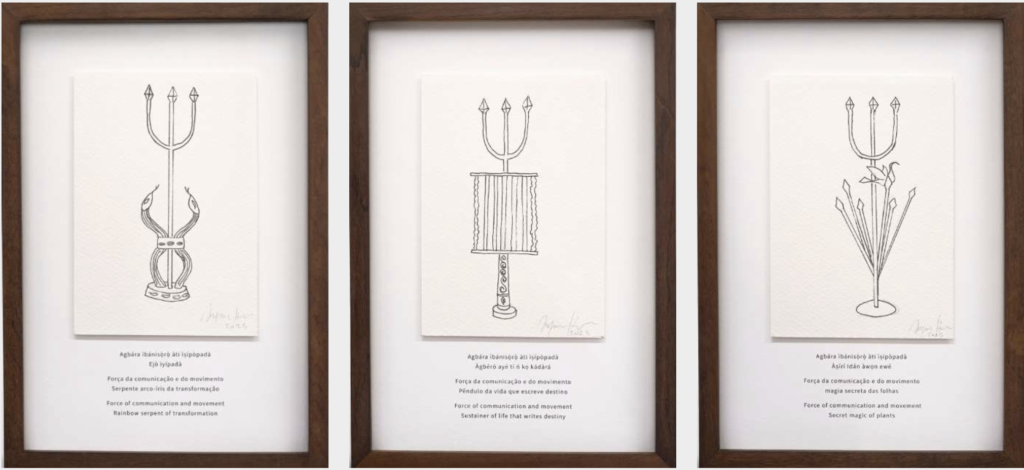
Together with this sculptural pantheon, the Juntó–Oríkì series of drawings unfolds across the walls like an open notebook. The project transforms Afro-Brazilian cosmology into an expansive visual and spiritual system functioning as a form of visual poetry and proposing instructions for what the artist describes as “cosmoperception.” These works are not merely representational images, but propositions capable of intervening in reality itself, inviting viewers into a somatic mode of thinking where the body becomes a medium connecting spiritual, ecological and ancestral dimensions. Conceived by Heráclito as a lifelong project, the artist ultimately hopes to realize all 222 sculptural combinations; so far, approximately 60 sculptures have been produced.
Unlike the organic totemic sculptures of Mestre Didi, traditionally composed of shells, beads and vegetal fibers, Heráclito constructs his sculptures from welded stainless-steel sheets. These almost planar forms abstract the symbols of the orixás into gleaming contemporary surfaces: Exu’s trident becomes a force of communication, while Xangô’s double-edged axe evokes justice and the fire of truth. Through industrialized materials, ancestral cosmologies are translated into a contemporary sculptural vocabulary without losing their spiritual force, combining monumentality with an unexpected softness and refinement.
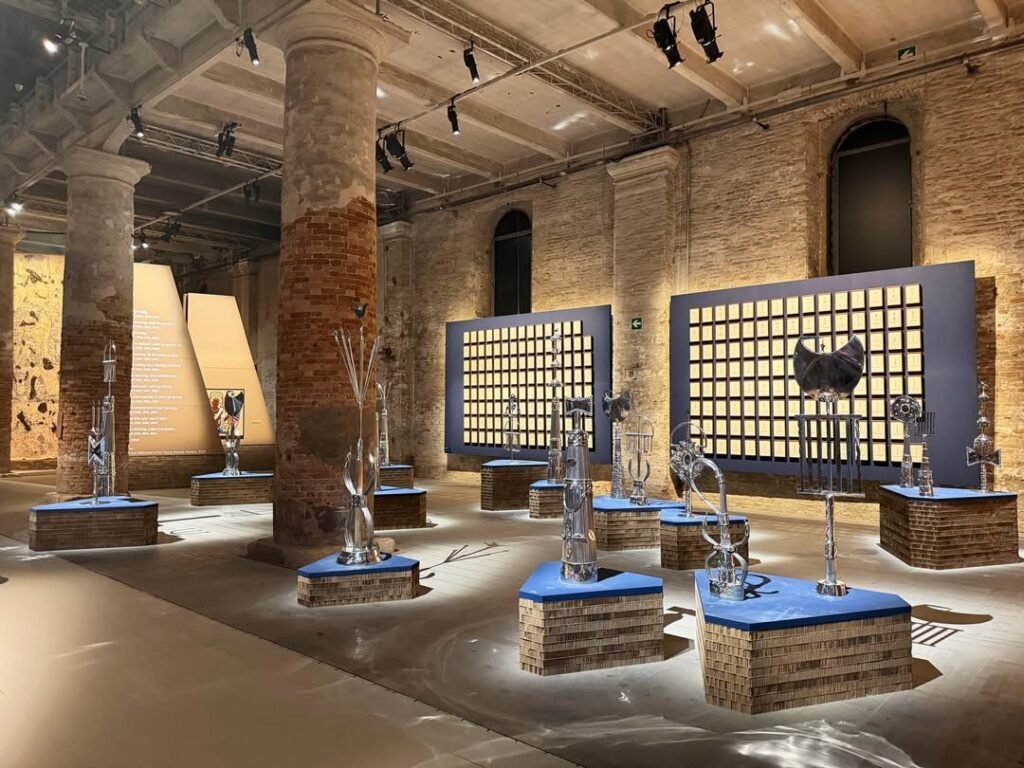
Prices currently range approximately from $30.000–60.500 for small, medium and large sculptures, while drawings are priced around $3.250 each. Certain monumental sculptures already exceed two meters in height, and the project also opens the possibility for site-specific public commissions on an architectural scale. One monumental version installed in Salvador reaches nearly 40 meters, revealing how Heráclito’s cosmological structures can expand from intimate ritual objects into vast spiritual architectures inhabiting public space.
The Biennale has also marked an important moment of international recognition for Heráclito’s practice. His installation received a particularly strong critical and institutional reception, attracting interest from curators, museums and residency programs from Africa, Mexico and beyond. Several sculptures and drawings from the series were acquired during the opening days, while institutions expressed interest in acquiring the entire installation of drawings as a museum ensemble.
Represented by Portas Vilaseca, Paulo Darzé and Simões de Assis, his works have recently entered major international public collections, reflecting the growing institutional recognition of his practice and of Afro-Brazilian contemporary art more broadly. His works belong to collections including the Art Institute of Chicago, Fundación TBA21, Museo Nacional Centro de Arte Reina Sofía, Museum der Weltkulturen, Raw Material Company, MASP, Instituto Itaú Cultural, Museu de Arte Moderna da Bahia, Museu do Homem do Nordeste, Museu de Arte do Rio – MAR, Associação Cultural Videobrasil, Pinacoteca do Estado de São Paulo and Inhotim. These acquisitions reinforce Heráclito’s growing international importance and the increasing visibility of artistic practices rooted in Afro-diasporic cosmologies within major museum narratives.
Eustáquio Neves: Photography as Living Archive
Eustáquio Neves, born in Juatuba and based in Diamantina, is one of the central figures of experimental Brazilian photography. His practice investigates the historical and social fractures connecting the past and present of Afro-diasporic presence in Brazil.
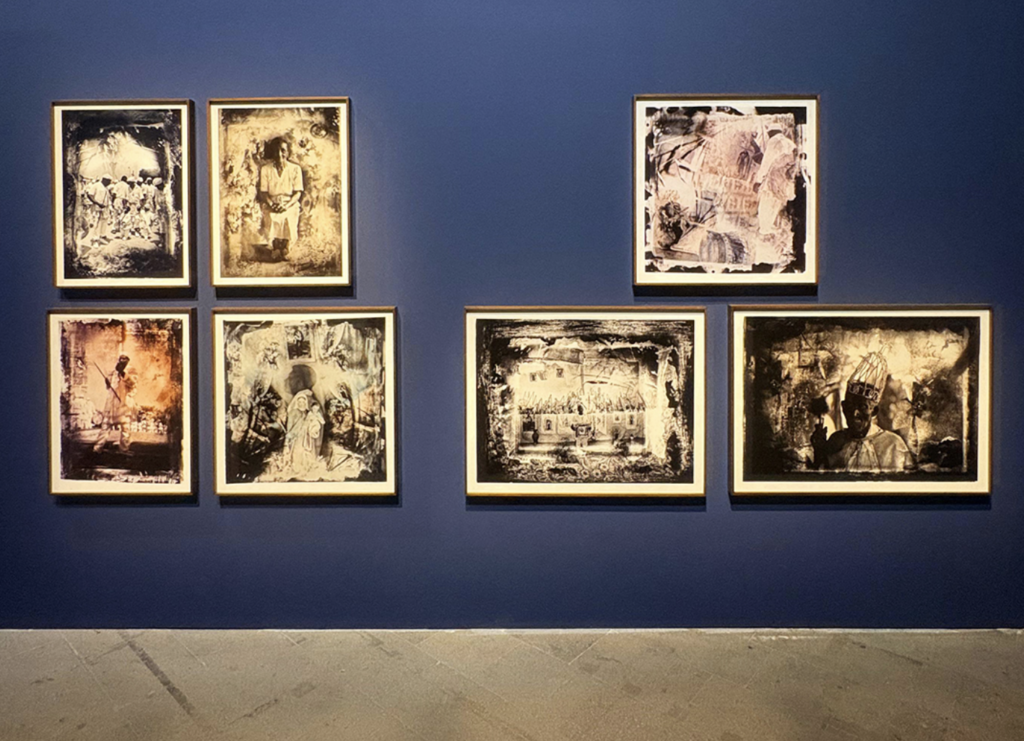
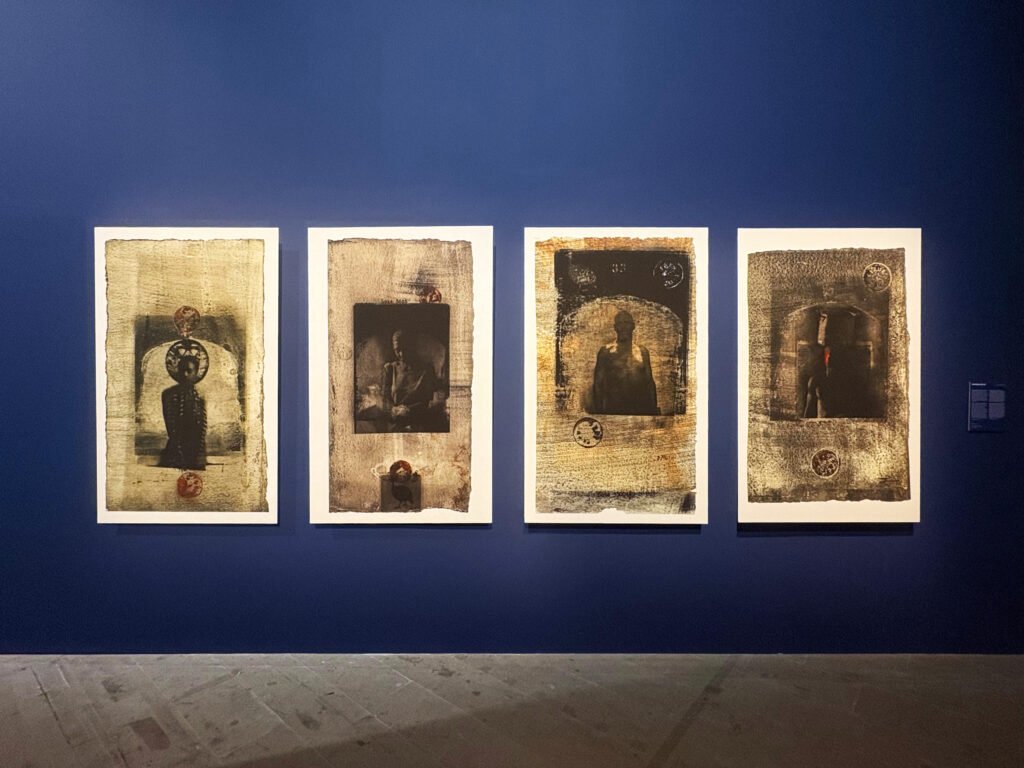
Through manipulated negatives, prints and chemical processes, Eustáquio Neves explores race, identity, memory and historical violence. His aim is for no individual to remain identifiable, transforming photography into a meditation on collective memory, mourning and survival. His images emerge as spectral archives, suspended between disappearance and permanence, with a striking attention to texture and material intervention that elevates them to the status of contemporary icons. Within In Minor Keys, his photography functions as a counter-archive: an image that does not merely represent history, but excavates it through traces, scars and layered memories.
This approach unfolds differently across the two series presented at the Biennale. Arturos, 1993–1995, one of Neves’s earliest and most emblematic bodies of work, emerged from his immersion within the quilombola community of Arturos in Minas Gerais. The series reveals ancestral knowledge, spirituality and Afro-Brazilian traditions that survived centuries of violence and erasure. Nebulous figures, overlapping symbols and scarred surfaces create images that oscillate between revelation and concealment, while references to Congado rituals and the influence of Arthur Bispo do Rosário reinforce the spiritual and symbolic density of the works.
In contrast, Cartas ao Mar, 2016 unfolds as a more mournful meditation on historical trauma. Developed after Neves’s encounter with the ruins of Valongo Wharf in Rio de Janeiro, once the world’s largest landing site for enslaved Africans, the series transforms anonymous faces, torn papers, ashes and scratched surfaces into symbolic messages cast into the sea of racism and forgetting. Unable to photograph the site directly, Neves returned to his studio and constructed images that seem to resurrect buried presences from the depths of history itself, transforming photography into an act of remembrance and symbolic repair.
Dan Lie: The Sublime of Life Transition
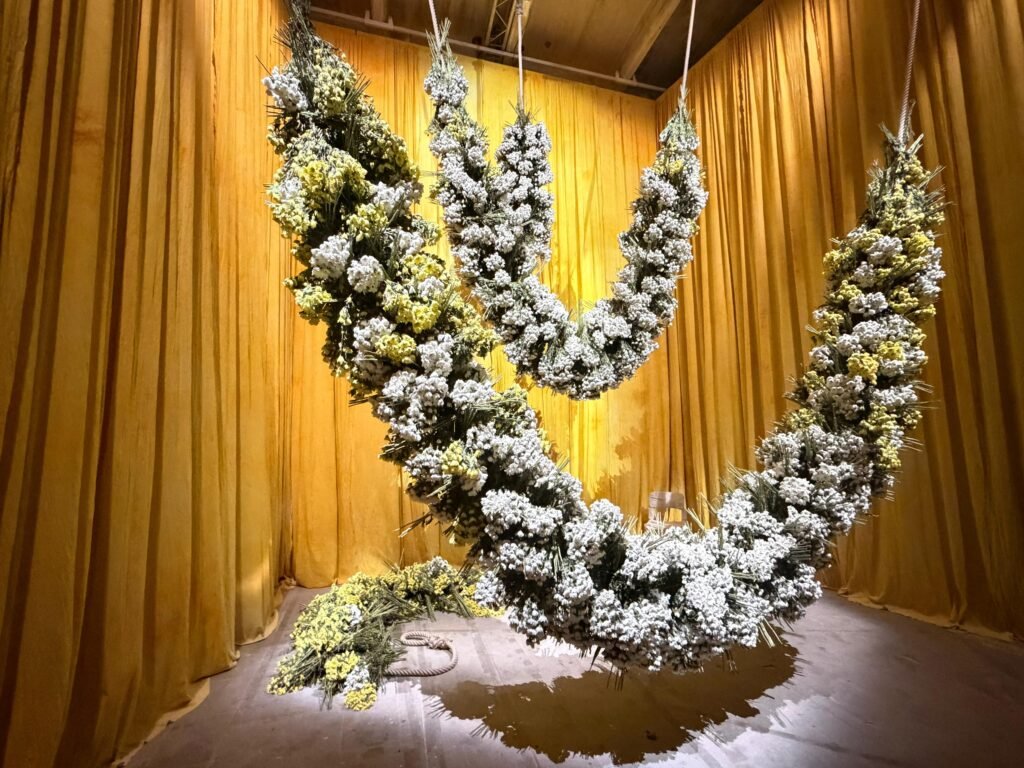
Dan Lie deserves a reading of their own. Within the context of In Minor Keys, their practice expands the Brazilian presence beyond fixed national identity. A Brazilian-Indonesian trans non-binary artist, Lie works with living installations developed in collaboration with fungi, bacteria, plants, organic matter and processes of decomposition.Their installations combine flowers, seeds, soil, spores, fabrics and ceramic vessels into living ecosystems that continue transforming throughout the exhibition.
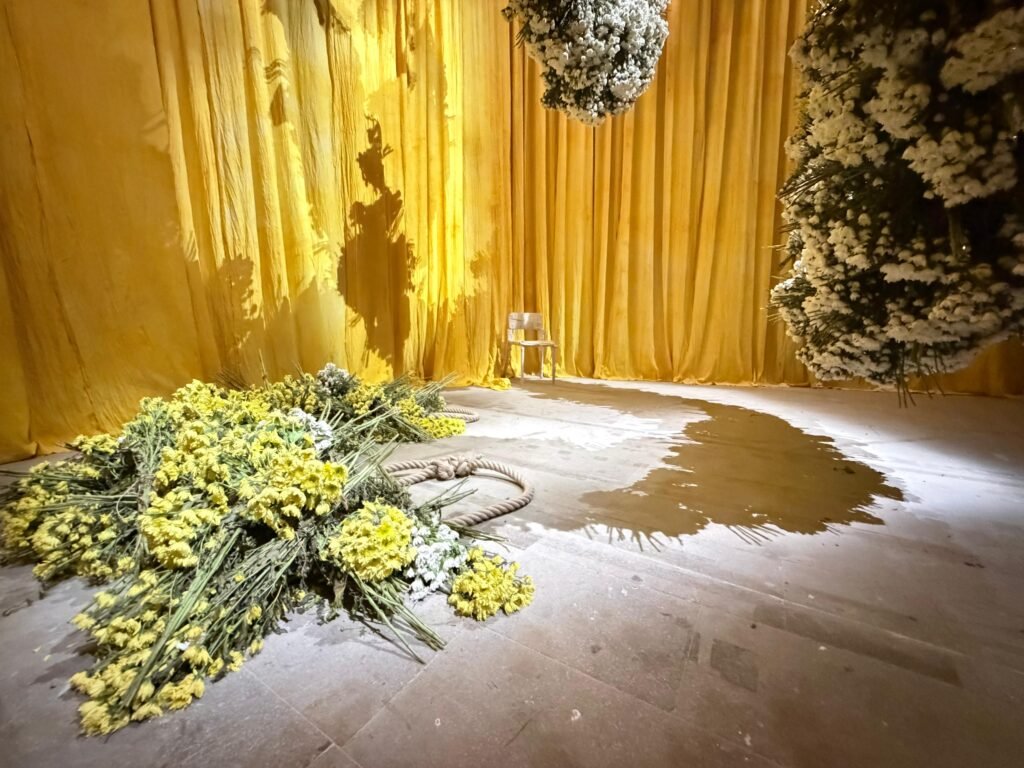
Their work investigates the porous boundaries between life and death, growth and disappearance, presence and transformation. It speaks of cycles, matter, mourning, non-human ancestry and expanded temporalities. By collaborating with living organisms, Lie displaces the centrality of the human and proposes an art that transforms, decays, breathes and disappears. It is an essential contribution to a Biennale that seeks precisely to slow down perception and listen to what normally remains invisible. At once shocking and deeply poetic, the installation directly evokes the flowers left in cemeteries and confronts viewers with the physical presence of death itself. The intense scent of vegetation entering putrefaction permeates the space, creating an unsettling sensory experience where beauty, fragility and decomposition coexist in a state of suspended transformation. The curatorial text by Thiago de Paula Souza describes how Lie’s practice focuses on “the transformations time imposes on organic matter,” understanding decomposition not as disappearance, but as passage toward other forms of existence.
Dan Lie is represented by Barbara Wien Gallery and has been presented at institutions including the New Museum, Art Sonje Center, Hamburger Bahnhof and Pinacoteca de São Paulo, as well as the Carnegie International, Singapore Biennale and the 35th São Paulo Biennial.
Thus, the Brazilian presence in Venice 2026 unfolds across multiple fronts: at the Brazil Pavilion, through the historical and symbolic force of Adriana Varejão and Rosana Paulino; and at the Arsenale, through the spiritual, photographic and organic density of Ayrson Heráclito, Eustáquio Neves and Dan Lie. What unites them is their refusal of a decorative reading of Brazilian contemporary art. Their works address trauma, memory, the body, coloniality, spirituality and transformation, themes that traverse not only Brazil, but the contemporary world itself.
The 2026 Venice Biennale ultimately asserts itself as an edition of contrasts: between mourning and permanence, institutional crisis and artistic potency, global politics and sensitive listening. For Brazil, it represents a moment of strategic visibility, but also of complexity. It is not merely about occupying Venice; it is about disputing narratives, reinscribing histories and demonstrating how Brazilian contemporary art participates decisively in some of the most urgent conversations of the present.
Punta della Dogana: Paulo Nazareth Rewriting Colonial Routes
The strong presence of Brazilian artists across the 2026 Venice Biennale extends far beyond the Brazil Pavilion and the Arsenale. Throughout Venice, Brazilian contemporary art emerges as one of the most conceptually and politically compelling presences of this edition, engaging directly with the Biennale’s broader themes of memory, displacement, spirituality and historical repair.
Within this context, Paulo Nazareth presents a major exhibition at Punta della Dogana, curated by Fernanda Brenner. The exhibition investigates colonial cartographies, forced displacement and Afro-diasporic memory, transforming history into a lived geography. Walking itself becomes both method and language in Nazareth’s practice, as the artist turns his body into a living archive of colonial histories and contemporary inequalities.
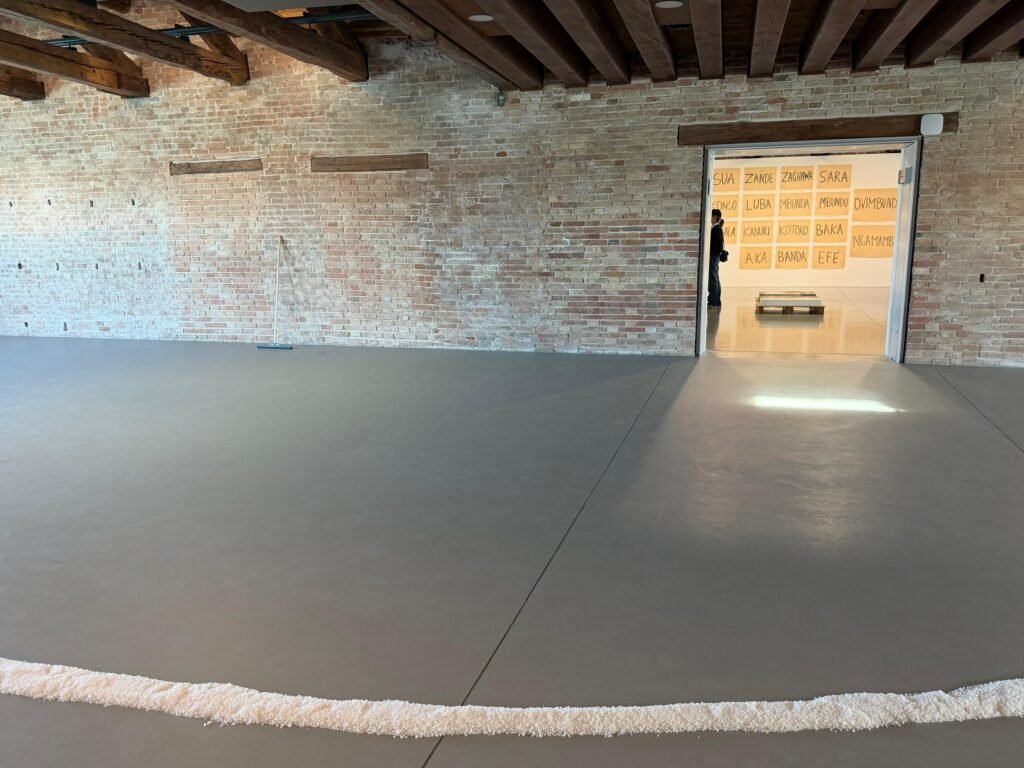
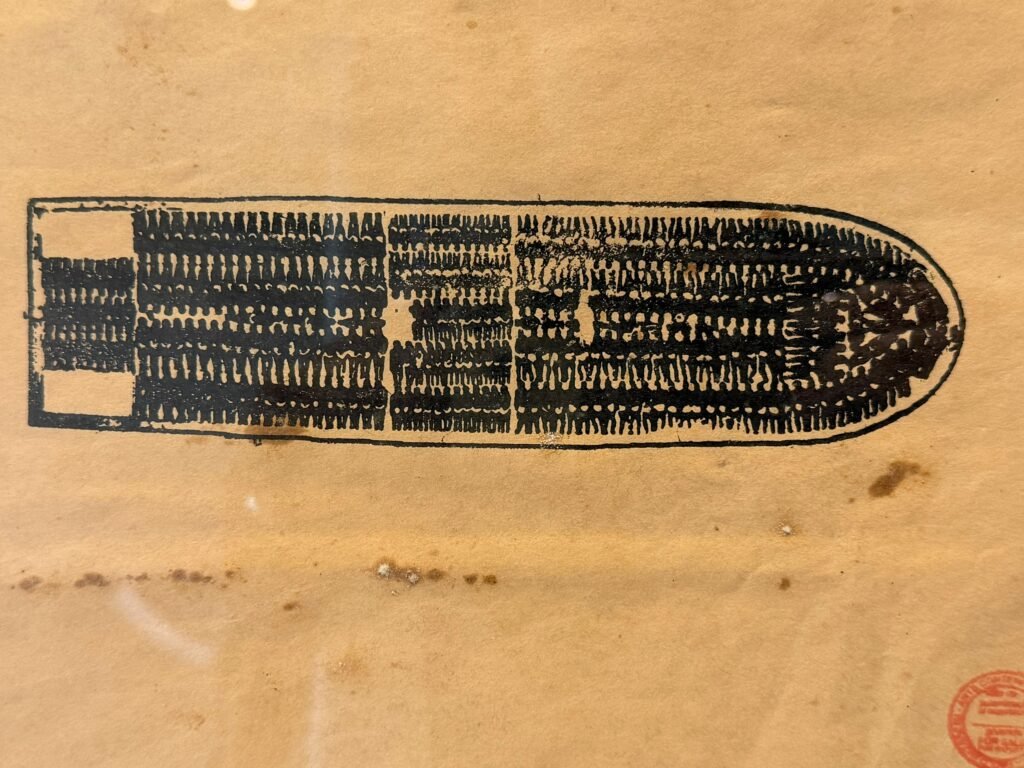
One of the exhibition’s central installations, The Wake, transforms the upper floor of Punta della Dogana into the full-scale outline of a slave ship drawn in coarse salt. At first glance, the work appears as a minimalist abstraction crossing the historic Venetian architecture; gradually, however, the fragmented lines reveal themselves as the structure of a tumbeiro, the Portuguese term used for slave ships that operated as floating tombs during the transatlantic crossing. Positioned where the Grand Canal meets the Giudecca Canal, the installation creates a powerful confrontation between Venice’s maritime history and the violent infrastructures of colonial trade. A smaller engraved drawing nearby exposes the geometric divisions of the ship’s hold, revealing how human beings were once calculated and organized as cargo units. Rather than functioning as a monument, the work evokes what theorist Christina Sharpe defines as “the wake”: the ongoing condition of living in the afterlife of slavery, where historical violence continues shaping the present.
Salt becomes an especially charged material within the installation. Historically central both to maritime commerce and to the preservation of provisions aboard colonial ships, it also carries strong spiritual meanings within Afro-Brazilian religions, where it is associated with purification and protection. Through this dual symbolism, Paulo Nazareth transforms a material historically tied to violence into one of healing and ancestral continuity. As visitors walk through the work, salt crystals slowly disperse under their footsteps and circulate through the building itself, suggesting how the memories of forced migration, displacement and colonial trauma continue to move invisibly through contemporary society.
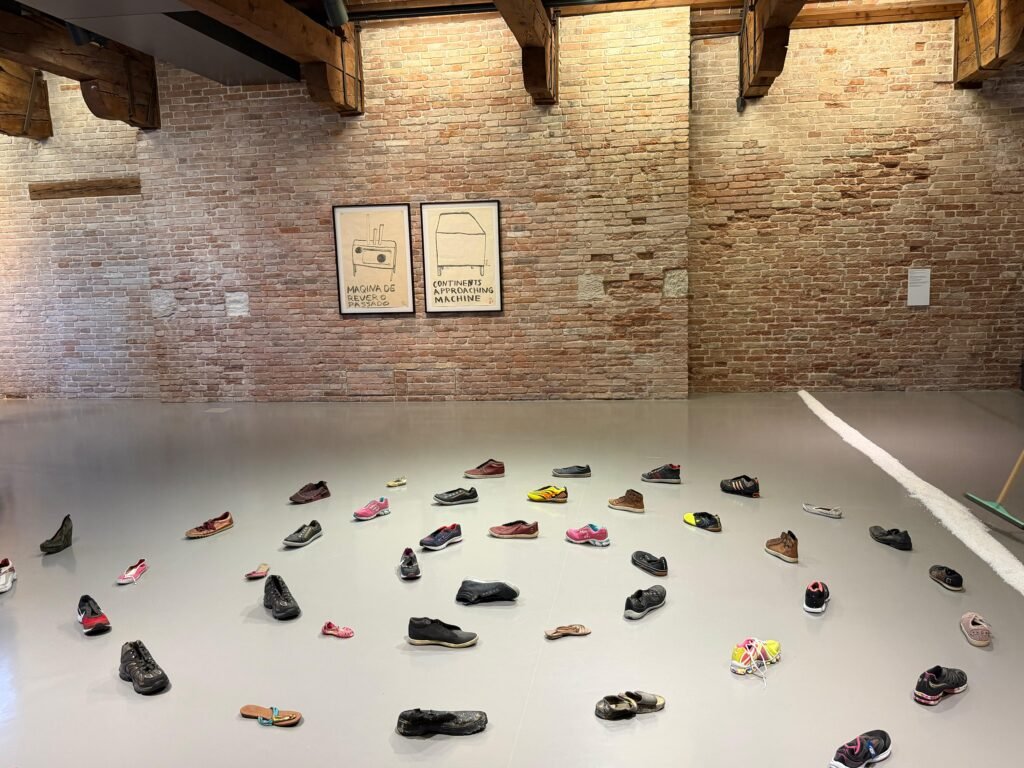
The installation unfolds through spirals of left-foot shoes collected from travelers and borderlands, evoking undocumented journeys excluded from official histories. Nazareth frequently walks barefoot himself, honoring enslaved ancestors for whom the absence of shoes functioned as a visible mark of subjugation. Following abolition in Brazil, shoes paradoxically became symbols of citizenship and freedom long denied to formerly enslaved populations. The work also incorporates embroidered representations of Exu and Zé Pilintra, presented not as folkloric figures but as spiritual technologies of survival, movement and resistance. Together, these elements transform the installation into a ritual space where memory persists through bodily experience, migration and spiritual continuity.
At Punta della Dogana, Nazareth creates a powerful dialogue between Venice’s maritime history and the violent histories of the Atlantic slave trade. Alongside artists such as Adriana Varejão, Rosana Paulino, Ayrson Heráclito, Eustáquio Neves and Dan Lie, his work reinforces the centrality of Brazilian contemporary art within some of the Biennale’s most urgent conversations: colonial memory, spiritual resistance, migration and the possibility of reimagining history beyond official narratives.
If you are interested in acquiring works by the artists featured in this article or would like to receive private market information, pricing details and availability, we invite you to contact Sophie Su Art Advisory directly through the WhatsApp button located on the right side of the screen. Our team accompanies collectors, institutions and private clients through acquisitions, strategic advisory and access to important works within the Brazilian and international contemporary art market.
Follow us on Instagram for exclusive insights into the international art world. Beyond the main Biennales and art fairs, we share curated discoveries from parallel exhibitions, emerging artistic scenes, private visits and institutional highlights across the globe. Through exclusive posts, market summaries and immersive reels, we aim to bring you as close as possible to the most important art events happening today, from Venice to Basel, New York, São Paulo and beyond.
Join us for a more intimate and informed journey through contemporary art, where critical perspectives, cultural context and on-the-ground experiences meet. You can access our Instagram by clicking the button below.