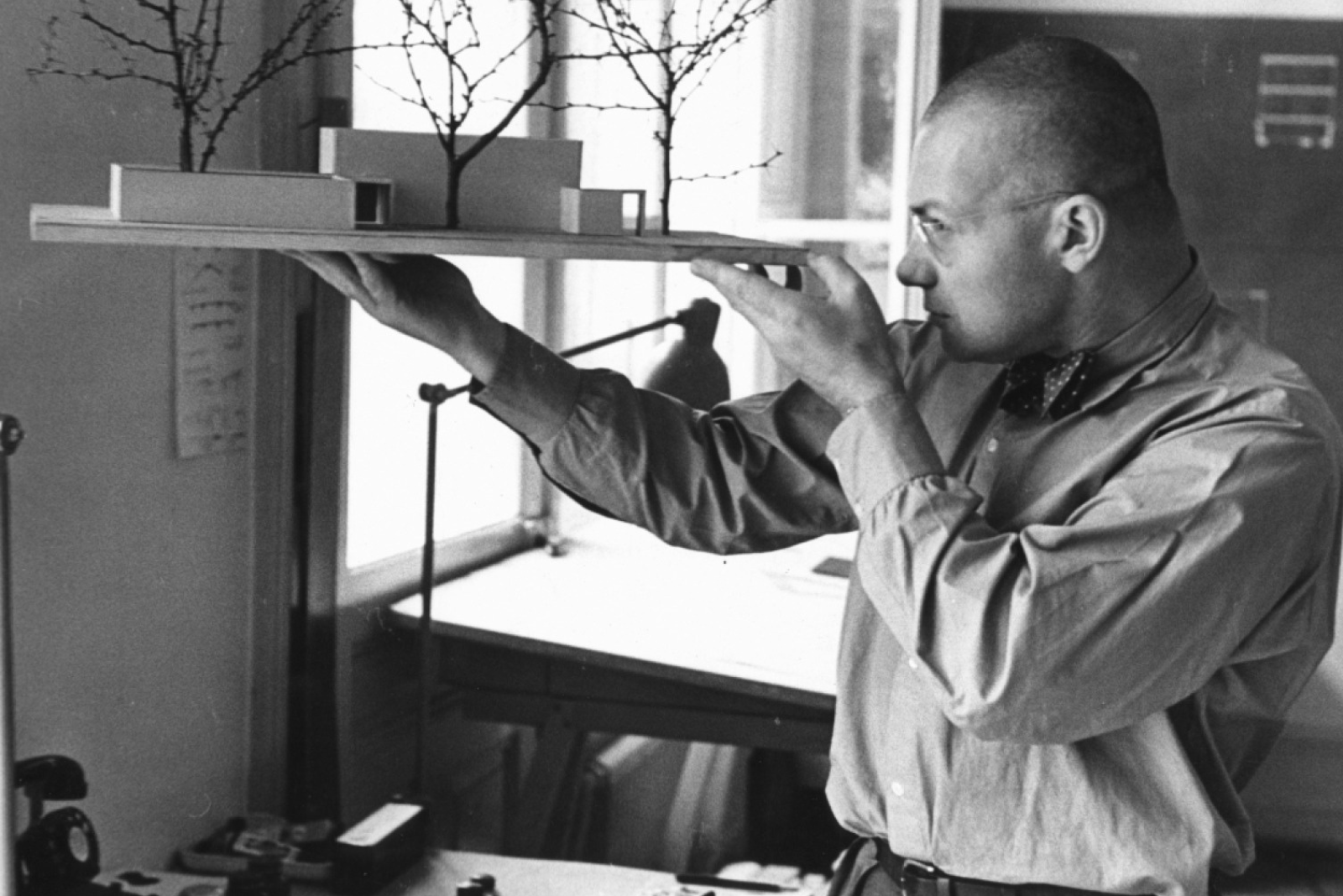
Max Bill was born in Winterthur, Switzerland, in 1908, and died in Berlin, Germany, in 1994. An architect, sculptor, designer, painter, graphic artist, theorist, and educator, he is considered one of the fundamental figures of Concrete Art and twentieth-century modernist design. Trained within the Bauhaus environment, his practice brought together mathematical precision, geometric abstraction, and a rigorous investigation of form, proportion, and spatial structure, reflecting his understanding of art as a rational, universal, and sensitive language. His sculptures, paintings, and design objects are marked by constructive clarity, formal economy, and the pursuit of a visual order based on systematic principles. In addition to his artistic production, Bill played a decisive role as a teacher and theorist, contributing to the international dissemination of Concrete Art and profoundly influencing the development of geometric abstraction in Latin America, especially after his retrospective at the Museum of Modern Art of São Paulo in 1951. His works are held in important museum collections, including the Museum of Modern Art — MoMA, in New York, and the National Gallery of Art, in Washington, D.C., as well as major public and institutional collections dedicated to modern art, Concrete Art, and design.