
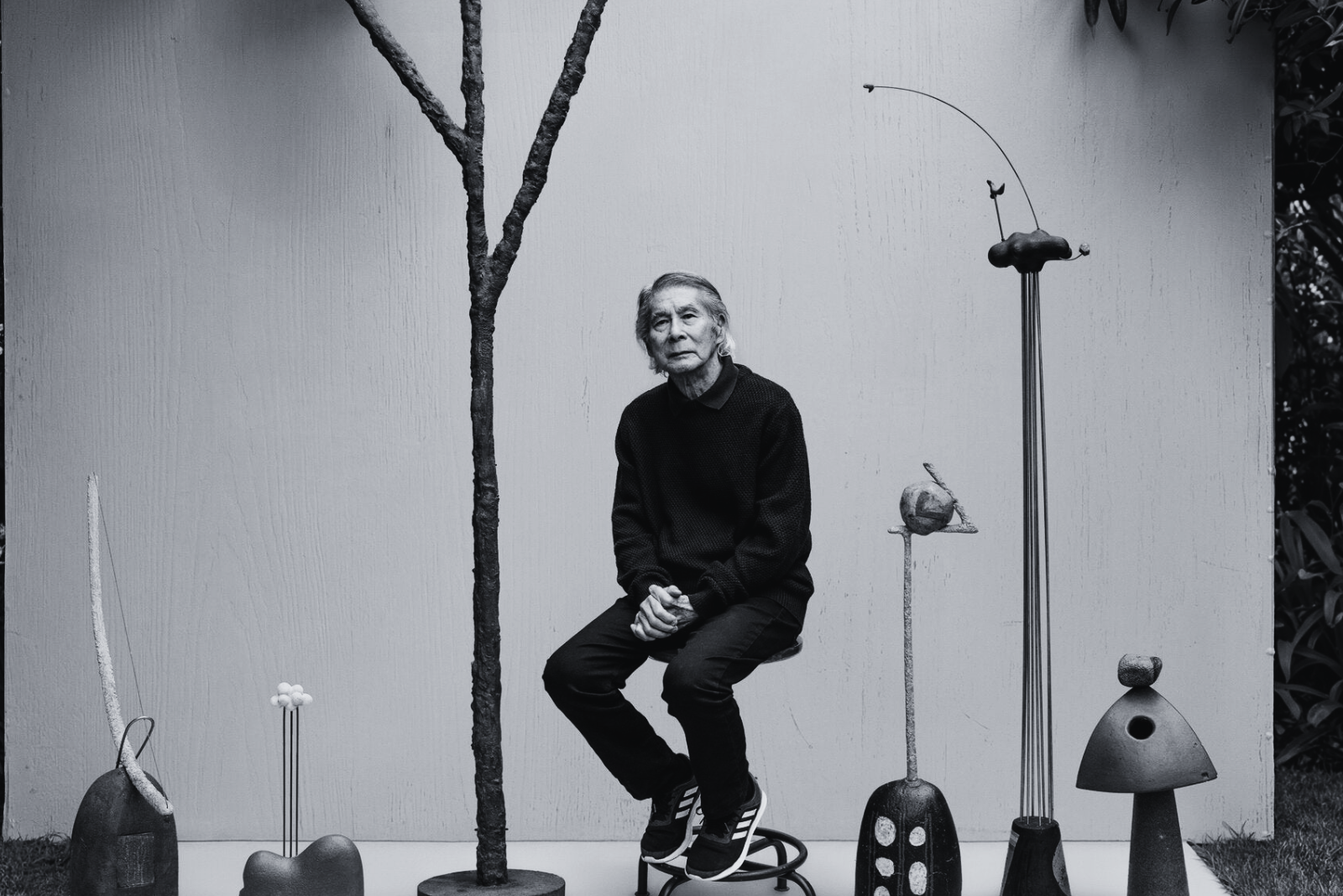
Megumi Yuasa was born in São Paulo, Brazil, in 1938, where he continues to live and work. A Brazilian sculptor and ceramicist of Japanese descent, he has developed a distinctive artistic practice that explores the relationship between materiality, nature, spirituality, and sculptural form. A self-taught artist, Yuasa began working with ceramics in 1964, experimenting with traditional techniques while incorporating unconventional materials such as metal, wood, stone, cement, and pigments. Deeply influenced by Japanese aesthetic principles, particularly wabi-sabi and shibui, his work embraces imperfection, simplicity, organic textures, and the transformative properties of matter. Through earthy tones, irregular surfaces, and experimental firing techniques, he creates sculptures that oscillate between abstraction and references to natural forms, often evoking trees, birds, and imaginary creatures. His celebrated Espássaros series, characterized by elongated, hybrid sculptural forms, exemplifies his poetic approach to ceramics and his exploration of the relationship between objects and their surrounding environment. Combining traditional craftsmanship with an experimental and philosophical sensibility, Yuasa challenges conventional distinctions between ceramics, sculpture, and contemporary art.
Throughout his career, he has participated in major exhibitions, including the 13th and 14th São Paulo Biennials (1975 and 1977), Laços do Olhar at Instituto Tomie Ohtake (2008), and Diásporas Asiáticas: Tocar a Terra at Instituto Tomie Ohtake (2024). His solo exhibitions include presentations at Galeria de Arte São Paulo (1987 and 1991), Gomide&Co in São Paulo (2024), and Letter to the World at Ortuzar in New York (2026). In 1988, he received the Sculpture Prize from the Associação Paulista dos Críticos de Arte (APCA). His works are held in prominent institutional collections, including the Carnegie Museum of Art in Pittsburgh, the Museu de Arte Moderna de São Paulo (MAM-SP), the Museu de Arte Contemporânea da Universidade de São Paulo (MAC USP), and the Pinacoteca de São Paulo, affirming his significant contribution to Brazilian ceramics and sculpture.
To provide the best experiences, we use technologies like cookies to store and/or access device information. Consent to these technologies will allow us to process data such as browsing behavior or unique IDs on this site. Not consenting or withdrawing consent may negatively affect certain features and functions.
Market reports for visionary collectors and insiders.